
In the morning, when the house is still quiet and Lynn is still asleep, the first thing I usually reach for is my phone. Not for the news, but for the small things. What’s in the calendar today? Is there anything in the junk folder that shouldn’t be there? What was the answer to that question I couldn’t let go of last night?
AI slipped into those moments without me ever planning it. If you had told me a few years ago that I’d be talking to artificial intelligence every day, I would have assumed you’d been watching too much science fiction. Now it’s just part of the day, somewhere between the first coffee and the inbox.
Mostly the small things
I work in IT, so new technology has always pulled me in. Even so, the way I use AI in my private life is surprisingly ordinary. How do I say this politely in German? What is actually the difference between those two washing machines? What exactly does this letter from the lease company mean?
What I like is that I don’t have to think about how to phrase my question first. I type or talk the way I would to a colleague. And I can keep asking. If an explanation is too technical, I ask for a simpler one. If something feels off, I push back. It feels less like searching and more like a conversation.
I don’t need to be an expert in everything. But I do like to understand things.
Not one tool, but a toolbox
Which AI do I use? That depends. Not because I want to try the newest model every week, but because I want to know what a tool actually does for me. Not in a benchmark, but on an ordinary Tuesday evening.
Right now, each tool has its own place. With ChatGPT, I turn a photo of an appointment into a calendar entry, complete with location and a route link. I also let it go through my junk folder regularly. I’m fairly strict about that: an email isn’t spam just because the subject line sounds suspicious, and if not everything has been checked, I want to be told. Honest beats fast.
I use Grok for direct, substantive answers. For a long time, it also ran a small team of agents for my website: one kept an eye on the writing style, another looked at structure and code. They remembered what we had agreed earlier, like no em dashes, and practical details only when they belong to the story. These days I do that work with Claude. Publishing is something I always do myself.
A third subscription
In October a Claude subscription joined them, at first mainly for writing. Its writing style suits a blog like this, where tone matters as much as content.
By now I also use it for other things:
- Writing and rewriting. A first draft for a blog post, a polite email to customer service, or a text I’ve already written that doesn’t quite flow yet.
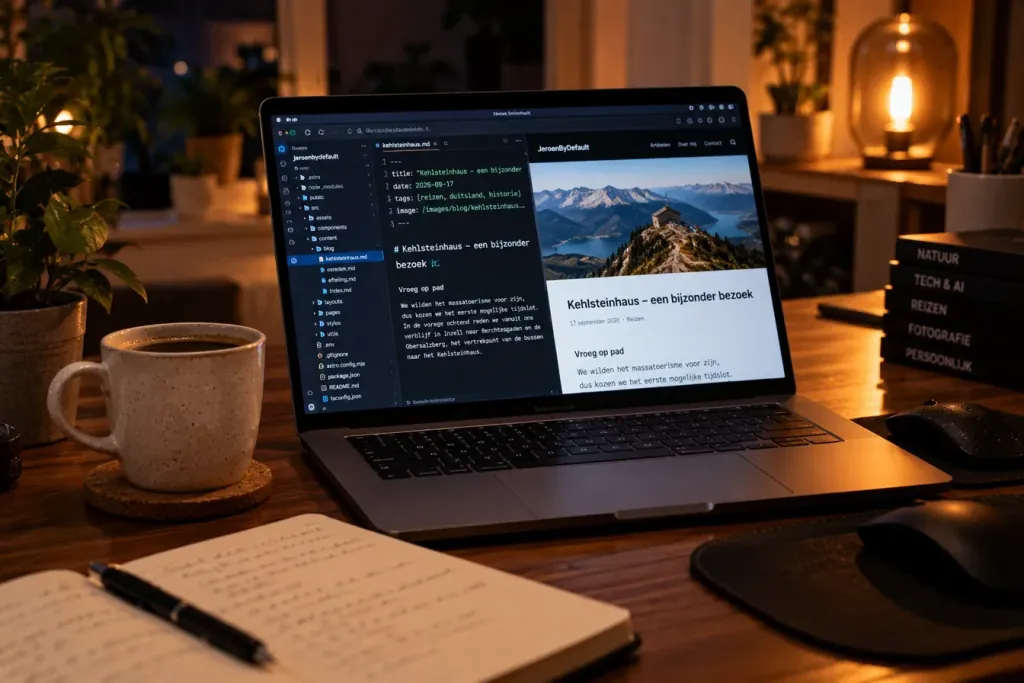
- My website. JeroenByDefault runs on Astro, with the code on GitHub. With Claude Code I update pages, review the repository and check the texts in Dutch and English. The Dutch text leads, the English has to follow it, and it helps when someone keeps an eye on that consistently. How I set up the site technically is a story for another post.
- Looking things up. The kind of question I would normally open ten browser tabs for, with sources included so I can check them myself.
- Daily planning. Claude can see my schedule through the calendar on my iPhone, which syncs with Outlook.
To be fair, running three subscriptions side by side feels a bit like having three remotes on the sofa. All three are still running for now, but I expect that to change soon. What I’m really after is one that’s versatile enough for all those different questions.
It has to stay my story
When it comes to writing, there is one rule: it has to stay my story. Sometimes I already have a finished text and want to know if it reads well. Sometimes I only have loose thoughts and need help turning them into something coherent. But I don’t want a website full of texts that all sound the same. My experiences, memories and opinions should still be recognisable. AI can help with structure and wording, not with my personality.
The same goes for our trips. When Lynn and I drove through Slovenia, Austria and Germany, AI helped with sights, routes and translating the odd message. But I like discovering things for myself. AI lays out the options, we make the choice.

And of course, Dribbel and Misty
If you know this site a little, you’ll know Dribbel and Misty show up regularly. Dribbel, our rather lazy and theatrical border collie, and Misty, the adventurous husky, are two plush housemates with a by now fairly elaborate fictional life.
To be fair, the real driving force behind their adventures is Lynn. She comes up with the plans and keeps their stories going on Dribbel and Misty’s Instagram ↗ (opens in a new tab). Lynn already works with AI too: she uses it to develop ideas further. I join in now and then. I enjoy seeing how other AIs respond to the same material, or what they make of it: a science fiction story or an image of them getting up to something completely ridiculous.

That might be the best part: being creative without it having to be useful.
Dribbel would say AI is mainly good for making him even more important. Misty has her doubts.
What doesn’t work yet
Not everything is perfect, and that’s worth saying too.
While I was driving to Schiphol to pick up my brother, his flight was delayed. All I wanted to know on the road was when he would land, so I asked ChatGPT through Apple CarPlay. Its voice mode could only tell me the original arrival time, not how late the flight was running. Asking again didn’t change that. Then I switched to Grok’s voice mode. At first it gave me the same answer, but when I kept asking, it did give me the right estimate, delay included. It shows how differently AI models handle the same question.

AI can also tell you something with great confidence that simply isn’t true. So I always check important information myself, especially when it comes to health, current events and actions in my own accounts.
Claude has its gaps too. It can’t simply read my personal Outlook mail; the workaround through the iPhone calendar does the job, but it isn’t a real solution. I’m toying with the idea of building my own connection on Azure, with two requirements: secure, and no monthly surprise on the bill. Occupational hazard, probably. I also miss image generation. I only make one or two AI images a month, usually of Dribbel and Misty, but that’s exactly when you don’t want to switch to another app.
What actually changes
The biggest difference isn’t one spectacular use case, but dozens of small moments. A question answered faster. An appointment that takes less manual work. A website problem I solve together with AI. Or a new Dribbel and Misty story that otherwise would never have been written.
I used to leave plans lying around because figuring them out took too much time. Now I take the first step much sooner. The bar for trying something has dropped.
What I’ve learned: the best AI isn’t the smartest one on paper, but the tool you still open after a few weeks. The one you trust to tell you honestly that something didn’t work, instead of pretending it did.
Right now, Claude is the one I use most. Will that still be true in six months? We’ll see. An answer is still a suggestion, not a fact.
Trusting AI is fine, as long as I keep thinking for myself. That seems like a good starting point.